The Hidden Cost of 'Getting Things Done': Why Constant Activity Can Be a Trap
Are you busy building, or are you building the *ability* to build?
The Busyness Trap: When Progress is Just Repetition
Think about your business. Are you constantly putting out fires? Are your teams perpetually 'busy'? Are you seeing a lot of movement, a lot of effort, but finding that certain challenges or tasks seem to resurface with uncanny regularity?
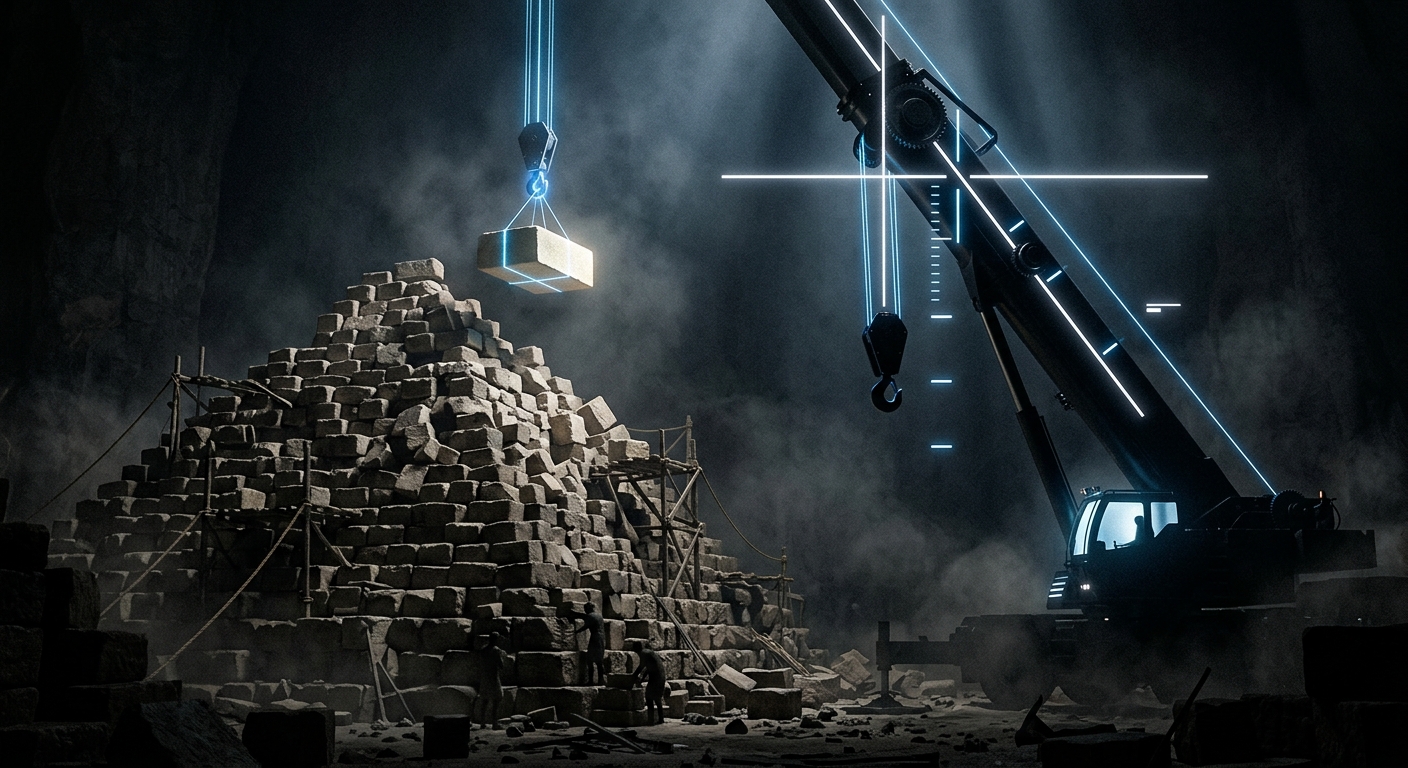
This is the trap of the first pyramid builder. He was incredibly busy. He was moving stones. He was making visible progress. But every single stone required a fresh application of manual effort. There was no cumulative advantage to his method, only a linear relationship between effort and outcome.
Why We Prioritize Activity Over Leverage
It's human nature, and often organizational culture, to value visible activity. Employees who are 'busy' are seen as productive. Managers who are 'hands-on' are applauded. There's a tangible satisfaction in seeing immediate results, even if those results are hard-won and not easily repeatable.
- Instant Gratification: Shifting stones now gives immediate feedback.
- Perceived Progress: Everyone can see the half-built pyramid.
- Lower Upfront 'Cost': Building a crane seems like a detour, an expense before any work gets done.
- Fear of the Unknown: System building often requires specialized knowledge, time, and looks like 'doing nothing' for a while.
This is why most businesses, particularly in their growth phases, default to being like Alex. They optimize for progress, for speed, for effort. They add more people, they work longer hours, they push harder. But they rarely pause to ask: 'Is this sustainable? Is this scalable? Or are we just getting really good at carrying heavy stones by hand?'
The Uncomfortable Truth: Leverage Looks Like Failure
The second brother, building his crane, looked like he was failing. He had no visible pyramid. He was investing time and resources into something that wasn't the final product. This is the hardest part about building leverage: it doesn't look like progress in the short term.
Automating a process, building a robust CRM, establishing clear standard operating procedures, developing self-service tools for customers – these are all 'cranes.' They require upfront investment of time, thought, and often money, with no immediate 'pyramid' to show for it. They look like internal projects, not revenue generators.
But the true cost of not building the crane is far higher. It’s the cost of constant re-work, repeated mistakes, inefficient scaling, and the perpetual feeling of starting from zero with every new initiative. It's the silent drain on resources and morale that comes from never quite getting ahead.
Breaking Free from the Cycle of Manual Labor
To break this cycle, you need to deliberately shift your focus from merely 'doing the work' to 'building the tool that does the work.' This means:
- Strategic Pauses: Regularly stepping back to review processes, not just outcomes.
- Investing in Infrastructure: Prioritizing systems and automation even when immediate results aren't obvious.
- Rewarding System Builders: Recognizing the value of those who optimize and streamline, not just those who execute.
- Adopting a Long-Term View: Understanding that slow, thoughtful beginnings can lead to explosive, sustainable growth.
Don't just build the pyramid; build the crane. If you only build outcomes, you start from zero every time. And in today's fast-paced world, that's a recipe for burnout, not breakthrough.
Book a Discovery Call if you'd like help with identifying and building your business's 'cranes'.